Banner photo by Sofie Forsström. Blog by Executive Director Shannon Frank.
Like a river with many tributaries that join to form a larger body of water, the Oldman Watershed Council (OWC) is made up of many pieces. Maybe you’ve seen OWC in the field, planting willows or taking water samples from a creek, or spoken to us at events throughout the watershed, or read an informative blog—but what happens behind the scenes to make our award-winning work possible? As a charitable non-profit organization, where does our funding come from, and how do we make decisions? What do we do to help communities and ecosystems in the watershed?
To answer these questions, we’re taking a peek behind the curtains at OWC in this three-part blog series. We’ll talk about the nuts and bolts of our organization, the importance of our neutral voice, and what we’re doing today that’s making a difference on the ground in the many communities across our watershed.
But first… what is a non-profit?
Before we dive in, a note about OWC’s structure: it is a charitable non-profit organization. If you’ve worked at, volunteered with, or engaged in some other way with a registered charity or non-profit, you might already know what that means, but we do get questions about it often.
The OWC has been registered as a non-profit society under Alberta’s Societies Act since 2005. What this means is that OWC operates without the intention of making a financial gain. In general, most funding that non-profits receive can be used only for certain activities. You can learn more about what being a non-proft in Alberta means here.
Non-profits are not necessarily charities—but OWC is, having taken the additional step of registering as a charitable organization with the Canada Revenue Agency. This federal distinction means that OWC can issue official donation receipts, must spend a minimum amount each year on its own charitable activities, can’t pay board members a per diem, and a few other things. You can view OWC’s reporting as a charitable organization here.
The OWC is one of about 170,000 non-profits and charities in Canada. As you can imagine, there’s a huge range of organizations from big to small that take on urgent social and environmental issues, and help drive our economy. Charities and nonprofits contribute $225 billion dollars in economic activity to Canada each year, and employ 2.7 million people—or about 1 in 10 workers—making this sector the largest employer in the country! So, where does OWC come in?
Who is on OWC’s staff and Board of Directors?
Both charities and incorporated non-profits are required to have a board of directors to guide the direction of the organization and oversee operations—so it’s never just staff members making all the decisions.
The OWC’s Board of Directors has 19 seats bringing diverse perspectives from many sectors and includes 4 members at large from the general public, with elections held for each position. Academia, health, all three levels of governments, environment, agriculture, irrigators, wildlife and habitat conservation, and Indigenous communities are all represented on our board. Our board members are leaders in their sectors, and several have served on the board for many years, providing invaluable leadership in OWC to work for holistic watershed health. Board chair Doug Kaupp, has served since 2013 while vice-chair Andrew Hurly has served for over 20 years, since OWC was created. This continuity gives OWC stability and builds institutional memory.
As for OWC’s staff, we have nine employees who, with a couple exceptions, all live, work and play in the watershed. Our team has expertise across many disciplines, among them science education, applied ecology, environmental restoration, ecosystem management, water and land resources, psychology, and journalism, and we have a Chartered Professional Accountant on staff to keep our finances running smoothly. We are a small team that shares a love for bees, gardening, dogs, and a good pun.
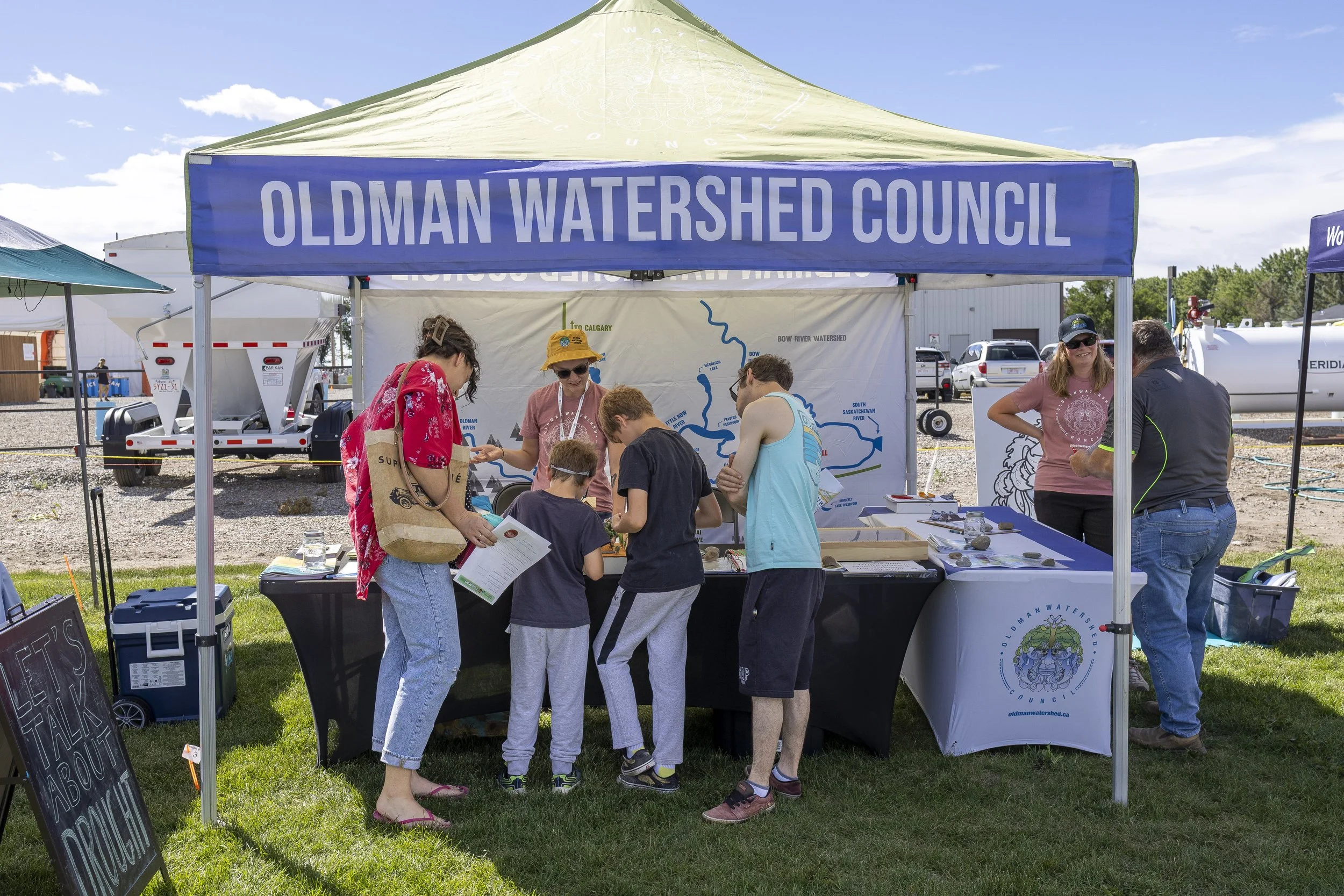
OWC staff speak to community members at Open Farm Days in 2025. Photo: Jon Martin.
What communities does OWC serve?
The OWC’s staff and board are most effective when we provide value to the places we work. The OWC’s support and community stretches across many places, people, and organizations in all directions of the watershed—from the Crowsnest Pass in the west to Taber in the east, and from Waterton to Milo and Nanton.
We connect with people in a number of ways: an email newsletter, social media, in-person events, a membership program, and volunteer opportunities.
Starting with our newsletter, we have a little over 3,100 subscribers. While we don’t have geographic information for all the folks on this list, we know that the vast majority live in Alberta. About 70 are out of province, including some in Montana, which the Oldman watershed extends into. Our subscribers live in over 120 cities, towns, and villages across Alberta. Within the Oldman basin, we have supporters from Aetna to Welling.
What does OWC’s membership look like?
The OWC’s membership program has over 760 members. About half are individuals and half are organizations, which represent municipal, provincial, and federal governments, First Nations, academia, agriculture producers, irrigators, commercial/industrial organizations, environmental non-government organizations, the health sector, and wildlife conservation. Our membership is varied across the watershed and Alberta more broadly.
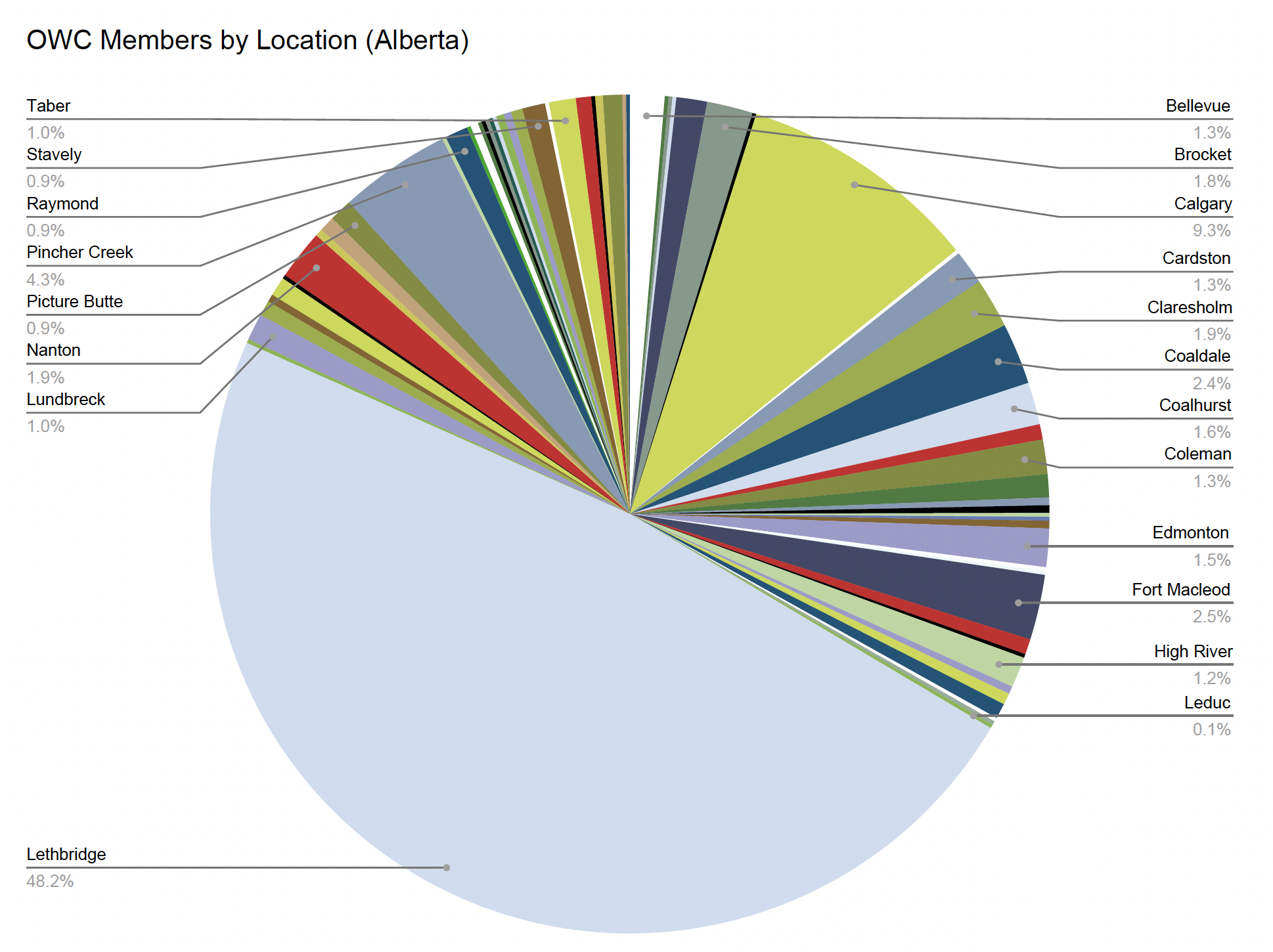
OWC members in Alberta live in Airdrie, Bellevue, Bentley, Black Diamond, Blackfalds, Blairmore, Brocket, Brooks, Calgary, Camrose, Cardston, Claresholm, Coaldale, Coalhurst, Cochrane, Coleman, Cowley, Crowsnest Pass, Diamond City, Diamond Valley, Duchess, Dunmore, Edmonton, Edson, Foothills, Fort Macleod, Glenwood, Hays, High River, Hill Spring, Hillcrest Mines, Iron Springs, Lac La Biche, Lacombe County, Leduc, Lethbridge, Longview, Lundbreck, Magrath, Medicine Hat, Monarch, Myrnam, Nanton, Nobleford, Okotoks, Picture Butte, Pincher Creek, Priddis Greens, Raymond, Red Deer, Redcliff, Rocky Mountain House, Rocky View County, Seven Persons, Shaughnessy, Spring Coulee, Spruce Grove, St Albert, Standoff, Stavely, Sylvan Lake, Taber, Turin, Twin Butte, Vauxhall, Vulcan, Warner, and Welling.
You can see that membership in Lethbridge makes up a big slice of the pie. Lethbridge also has the biggest population in the watershed and is the biggest municipal consumer of water, so this makes sense. However, OWC does not work exclusively in Lethbridge. In fact, a large portion of our work takes place in the headwaters in the eastern slopes, making sure that there are sufficient, clean water supplies for all the communities in the watershed.
As a charitable organization, OWC accepts donations and issues tax receipts. We are very thankful to the 77 donors who chipped in to support our work in 2025, and the 409 people who have made a donation between 2007 and today. As with our membership, these contributions come from both organizations and individuals—in fact, it’s about a 50-50 split, with 204 organizations and 205 individuals—most of whom are spread across many different towns in southern Alberta.
And that brings us to the always taboo question of funding.
Where does OWC’s funding come from?
As one of eleven Watershed Planning and Advisory Councils in Alberta, OWC gets some funding from the provincial government. That seed funding makes up about 16% of our budget because we use it to get more money elsewhere—from other government programs, grants, and partnerships—so we can do more to help our watershed and the communities in it.
Our funders and donors are listed on this webpage, with more details about funding broken down by program in our most recent Annual Report (starting on p. 8). You’ll notice OWC has many different sources of funding—last year, over 80—which includes individuals, organizations, and programs that have confidence in the effectiveness of our work.
This work is never done in isolation. In 2024–2025 we received an incredible amount—$503,200—of in-kind support from 167 partners and volunteers. It’s thanks to this widespread support that OWC can make a difference to watershed health and water security.
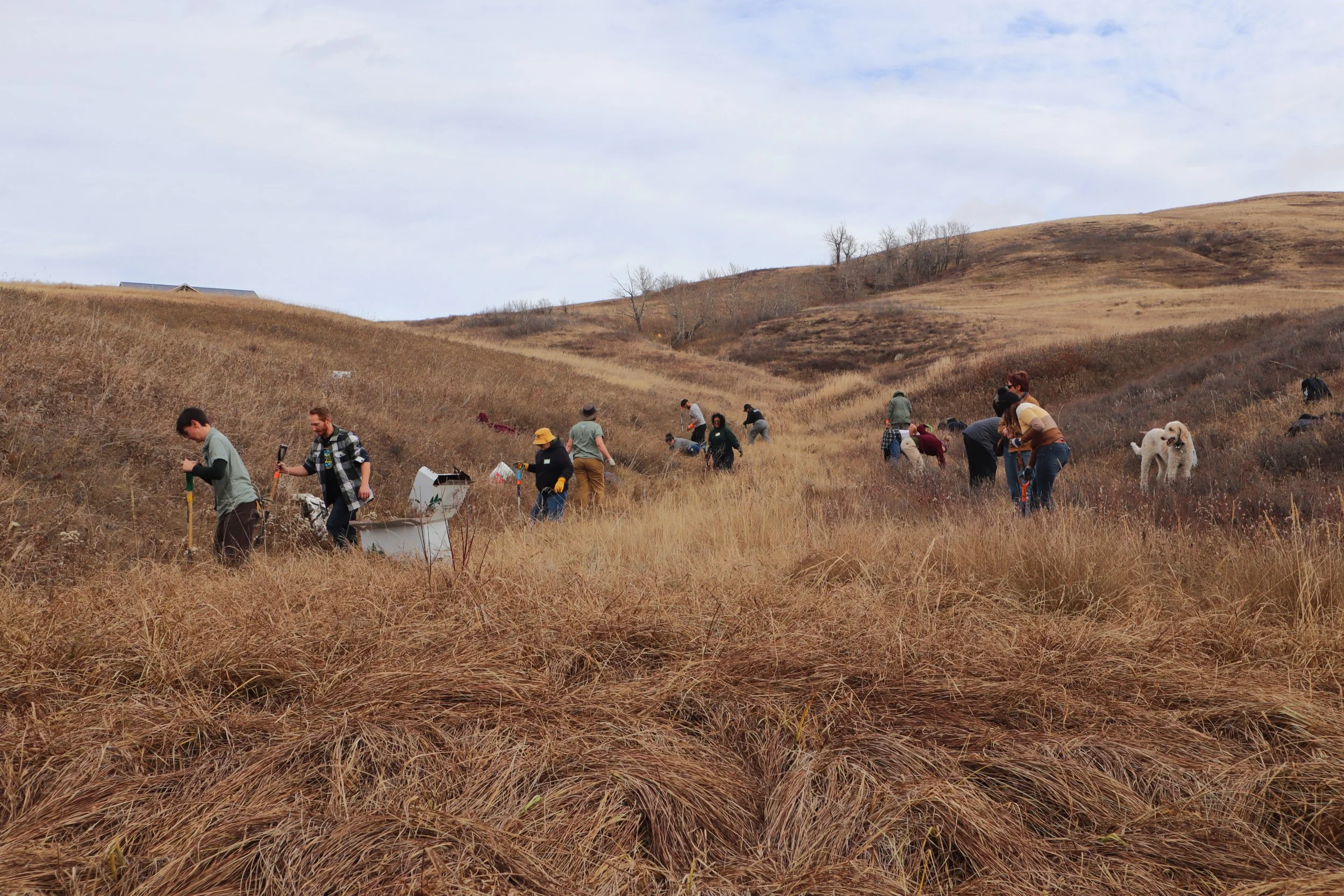
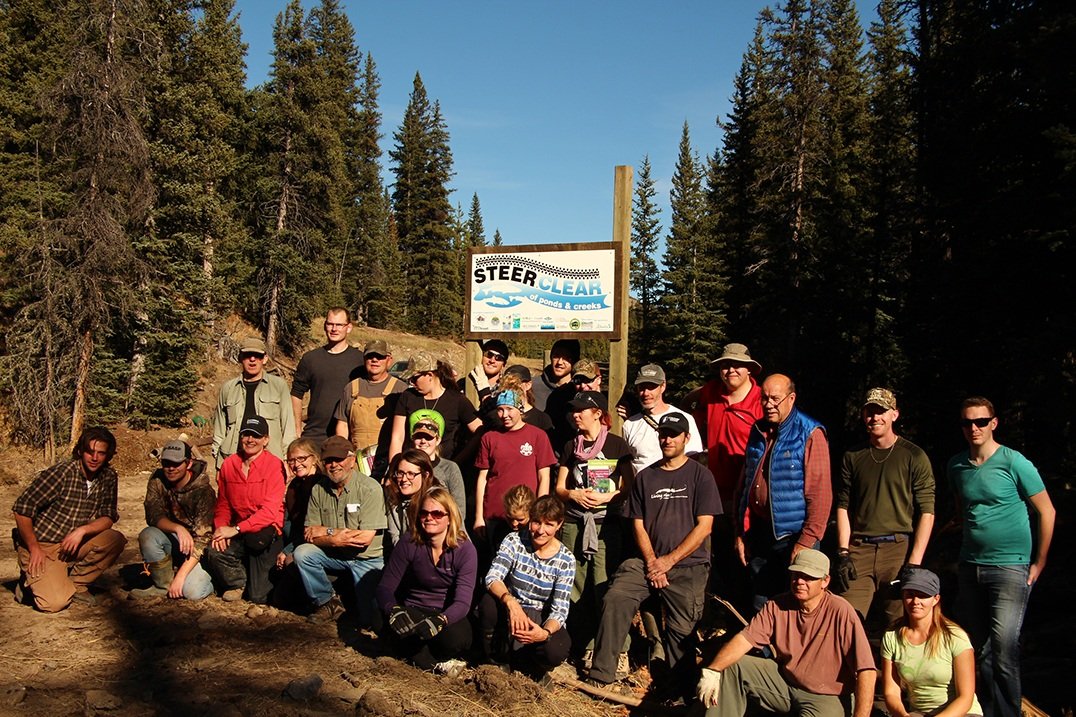
Partners and volunteers are a huge part of the work OWC is able to do! Photo: OWC.
This is critical work because we are all dependent on the same watershed. As a local organization, we live here. Like you, we depend on the health of this landscape and on our neighbours working together. In a drought-prone region with lots of demands for water from people and industry, this is a practical reality: our water depends on the people and good management upstream, and vice versa: what we do affects the people downstream. Just think of how invasive species or pollution spreads, and how that affects the next people who use that water.
We all depend on the same water source, and for us in the Oldman basin, that’s the headwaters in the eastern slopes.
Our work is connected to water
Cooperation is essential to ensure adequate supplies of clean water. In 2024, for example, a voluntary water sharing agreement was signed by major users of the Oldman River and the southern tributaries of the Oldman watershed. The successful collaborative work through this process taught us that together we can reduce our water use quickly when we need to during times of drought. You can read more about water sharing here.
Zooming out a little further, Alberta has an Apportionment Agreement with Saskatchewan that guarantees at least 50% of the total annual water from the South Saskatchewan Basin (which the Oldman basin is part of) will flow into Saskatchewan.
It’s part of OWC’s role to bring various parties together to find common ground and work together on the water security issues that affect all of us. With our watershed covering such a large area of land (23,000 km² in southwestern Alberta) and facing several challenges, cooperation is critical.
In summary
The OWC is a charitable non-profit whose work is guided by a diverse Board of Directors and a small staff. We serve communities across the watershed, connecting with several thousand people via our newsletter, over 760 people via our membership program, and dozens of donors each year. In addition to donations, OWC receives operational funding from the provincial government, which makes up a small portion of our budget alongside many other grants. The OWC also works with many amazing partners, and receives hundreds of thousands of dollars worth of in-kind support from partners and volunteers. All this adds up to a bigger difference to watershed health and water security—which are crucial to life in this region.
Now that you know about the people behind OWC, how we are funded, and how we operate as a charitable non-profit, the next question is how we operate as a neutral convener. In our next post in this series, we’ll delve more into why neutrality is important for watershed work, and how OWC makes decisions within this framework.
Like all OWC’s blogs, this post was written by a real live human, without the use of generative AI.