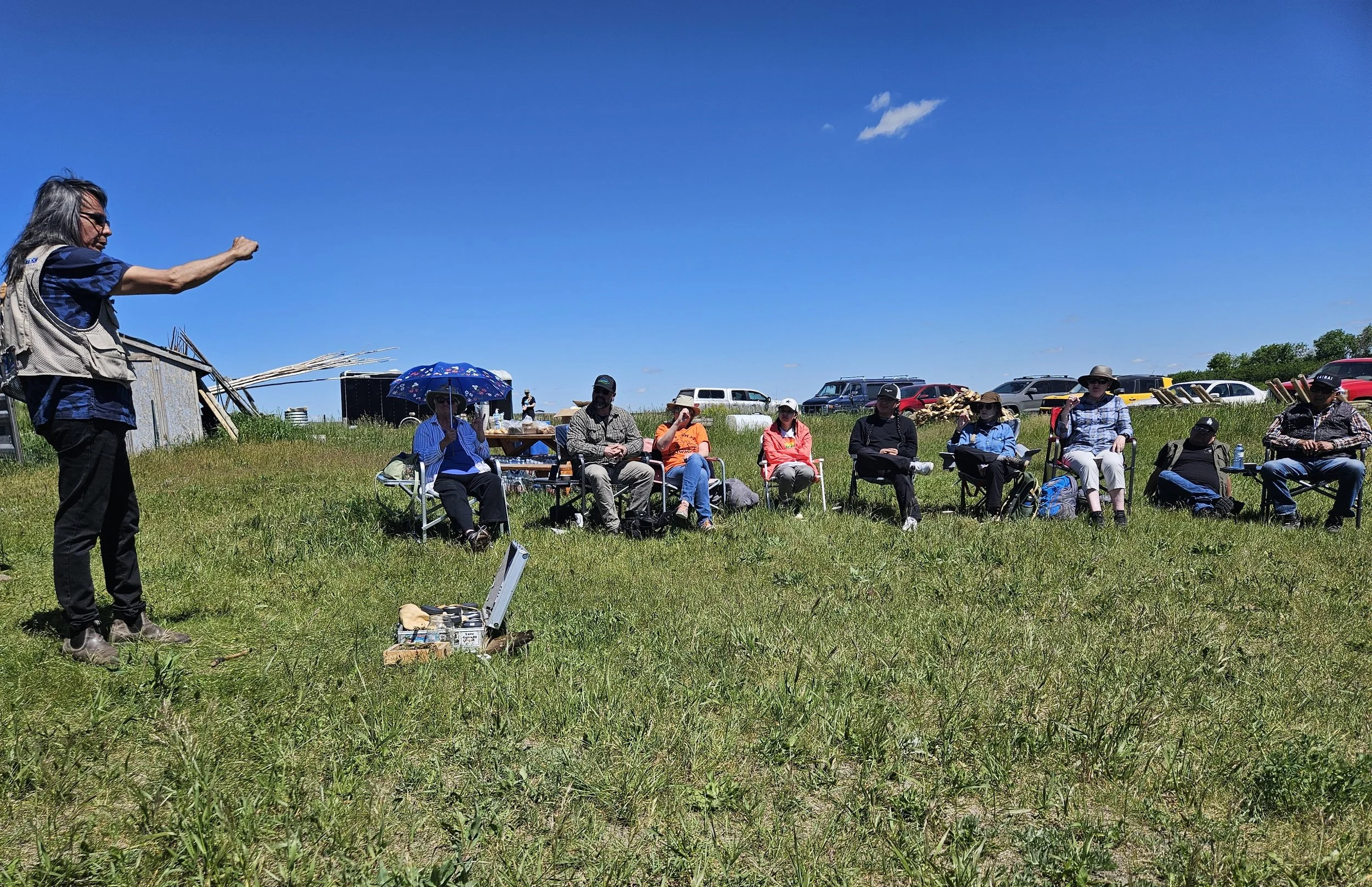
Api’soomaahka (left) presents on Naapi's Garden and his work educating the community on native plants at the Kainai Ecosystem Protection Agency’s annual summit in June 2024. Photo: OWC. Blog by Watershed Stewardship Assistant Chantel Youmans.
Welcome to the Watershed
In October, we were thrilled to host our first Authentic Watershed Experience, a full day outdoor workshop where community members joined the Oldman Watershed Council (OWC) in the Porcupine Hills to learn about what keeps our watershed thriving. As part of this initiative, we were privileged to have Api’soomaahka (Running Coyote, William Singer III) of Kainai Nation make time to share some of his extensive knowledge on prairie ecology and the deep significance of prairie plants in Niitsitapi (Blackfoot) culture as food and medicine.
The best way to learn about the landscape we call home is from people who are connected to and familiar with that land, and Api’soomaahka is certainly no stranger to the prairies. As the founder of Naapi’s Garden and Katoyiss Seedbank, he is dedicated to conserving native plants that are integral to Niitsitapi agriculture and ecological systems, such as sipátsimo (sweetgrass) and otsipíiistsi (willows). He is also very involved with the Opokaa’sin Early Intervention Society and school, where he uses plants to connect children with their culture, community, and the landscape around them.
The following is a reflection on my experience learning from Api’soomaahka and the prairie itself.
Plants of the Prairies
Api’soomaahka began his presentation by telling us about the snow-kissed mountains we can see shining clearly in the afternoon sun. They are known as Pani’kahtaa’tsis, the Tipi Liners, as they act like the protective inner liners of a tipi that would keep it warm and strong, and their changing appearance in different atmospheric conditions would predict the weather. We spent the day to the east of those mountains, known as the Livingstone Range, in the Porcupine Hills nestled at their feet. The Porcupine Hills are like the door to the tipi, inviting us in, and Api’soomaahka considers this land as “one of the last few wild places” where you can still find many plants native to the area.
All education, from every culture, comes originally from the land, Api’soomaahka says. When education about our landscapes exists only indoors, without exposure and connection to the elements, critical parts of the teachings are lost. This is why Naapi’s Garden was created, in order to heal the land and help preserve the culture, history, and ways of life that are critical to survival for the Niitsitapi. When a plant is lost, so is that part of the language and culture. Sharing the names and the stories of the plants and animals found here, in a space where we can see and touch and smell these elements of the landscape, enriches understanding of the land while sustaining these teachings for generations to come. As Api’soomaahka speaks, I can also hear the wind rustling through the deep-rooted prairie grasses; closing my eyes, it’s easy to imagine a herd of elk browsing on the shrubs and plants here, perhaps as a hawk soars lazily overhead.
In his day-to-day life as a pre-school teacher, Api’soomaahka explores what knits cultures together and bridges gaps in age and knowledge. The main connecting piece, he says, is food. Working with three- to five-year-olds can present some unique challenges, like the best way to spark their curiosity and hold their interest. One of the first things humans learn about and connect to in life is the food we share with our family, so food is the route that Api’soomaahka chooses to begin teaching children about their culture and history. Families with young children at home know first-hand how voracious they can be about berries, and Api’soomaahka’s students are the same: ókonokiistsi, or saskatoon berries, which grow naturally here in the Porcupine Hills, are a class favourite and one of the first to be eaten as he teaches.
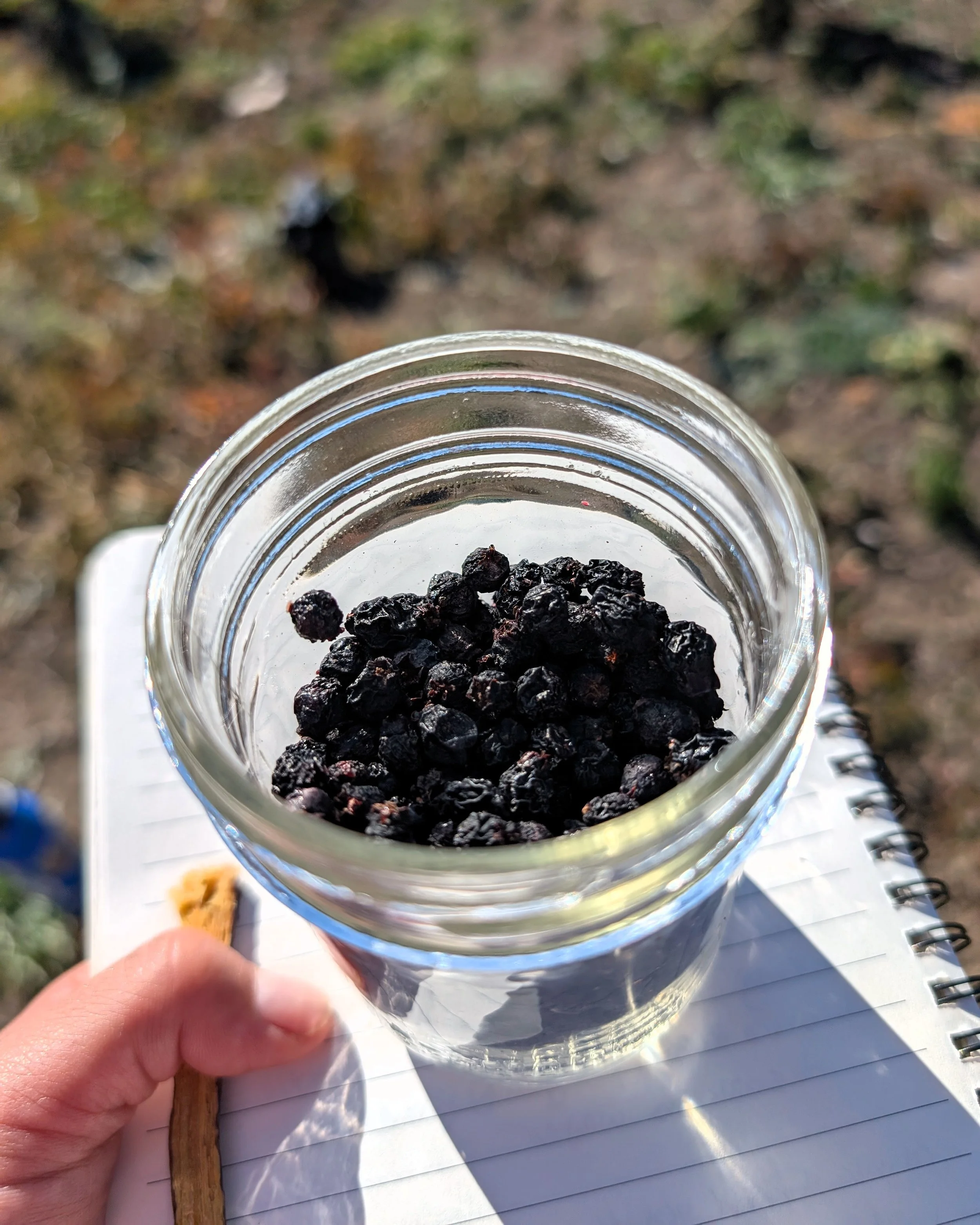
Saskatoon berries are delicious, and they also form the basis for many different lessons for the children, like making dye from the berries as a science project. Photo: Chantel Youmans.
Reaching into a well-loved silver case covered in stickers (one that he says has become his trademark to the kids), Api’soomaahka began pulling out vials of dried plant leaves, berries, and twigs to share with us. He passed around a vial of dried kaksamis, or sage, encouraging us to take a leaf to feel, smell, and taste. Sage is an extremely important plant with many uses in food, medicine, and cultural practice. For example, it can help a person blend into the landscape and mask their scent. Api’soomaahka attested to just how well sage works for this purpose. One morning, as he collected pisatsiinikimm (wild onion) in a timber patch, a deer passed by him mere feet away, calmed by the familiar scent of the sage.
Learning from the Landscape
Developing a personal relationship with the landscapes we call home—no matter how long we’ve been living here—helps us to learn about them, and how we can better care for them. A place-based sense of belonging can always be enriched. Whether you and your family have spent five generations or five minutes here, there is a place for you on the landscape, and countless lessons still to be learned. I may not have grown up here, but for many years now, the prairies have been caring for me. By working on and learning from the land, my sense of place has blossomed as I continue to cultivate a relationship with the ecosystems supporting me. The longer I spend exploring and learning, the more I’ve learned about the subtle patterns and processes at work here. Every new experience, like seeing a fox sprint through the coulee or the first delicate crocus blooms, is a gift I wouldn’t have received if I hadn’t begun building an intentional connection to the environment around me.
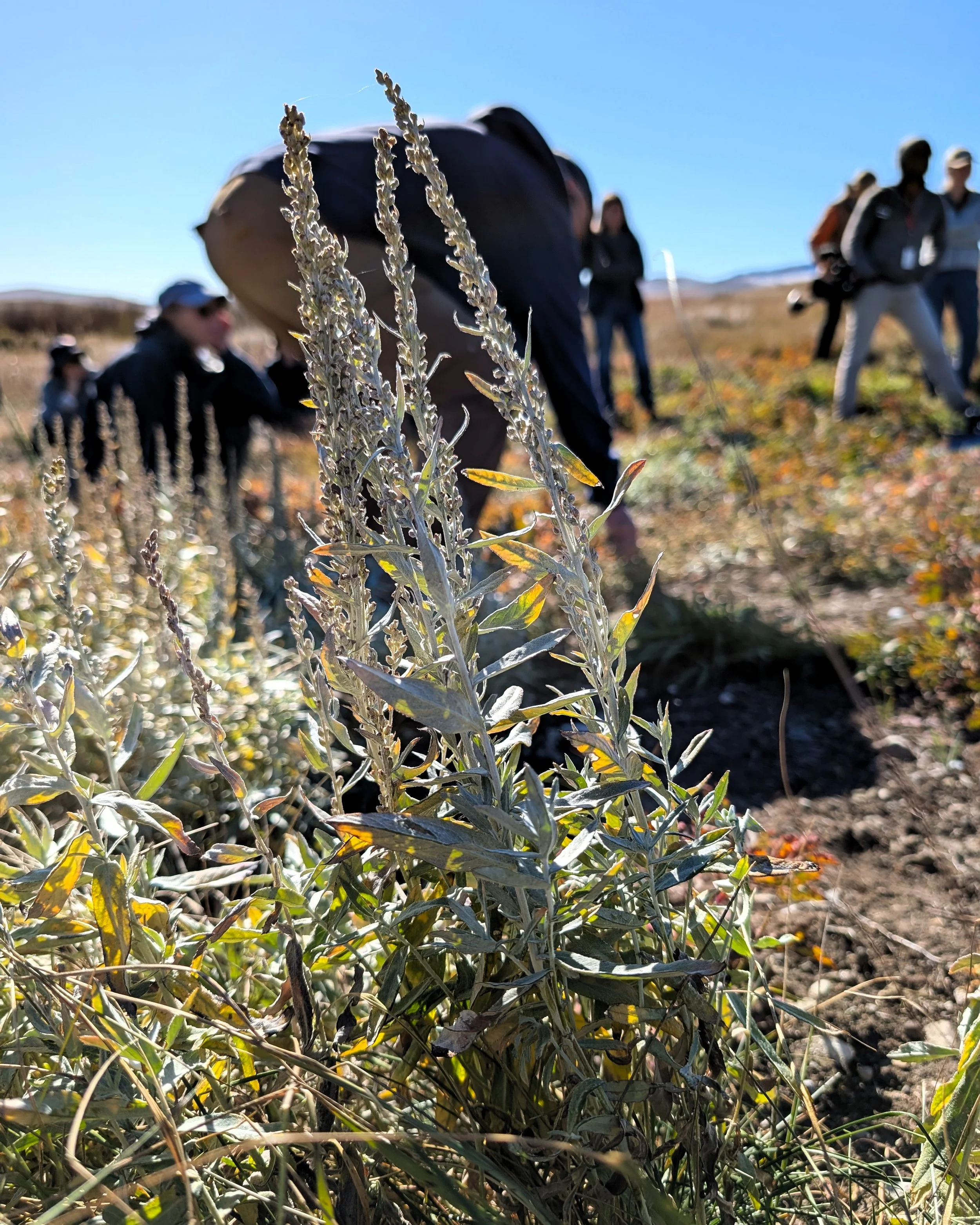
Not only did we get to sample some of Api’soomaahka’s dried sage, but there was also fresh sage growing under our feet that we might have missed if he hadn’t pointed it out for us. Photo: Chantel Youmans.
Similarly, when we invest time and energy into understanding our local ecosystems, we can better predict how events may impact them and better provide the things they need to thrive. Actively visiting the landscape and seeing how it responds to drought, wildfire, or restoration initiatives informs our decision-making and enables us to tailor our efforts to make them even more effective. The ecosystems around us are constantly shifting and adapting, so we can’t assume that each season will look the same or that the response to restoration efforts will always be predictable. Many ecological processes that take place on the prairies do so in cycles of years, decades, or centuries, which means we need to examine the landscape over time to develop an understanding of those relationships and characteristics. Taking time to visit nature consistently, and to learn about the plants, animals, and insects that also make our watershed home, builds a deep and comprehensive understanding of the land. When we know the land like we know our own homes, we can protect it the way it deserves.
Lessons for the Long Run
The Niitsitapi have been caring for the lands and waters within our watershed and beyond since time immemorial, and their relationship with the environment has been fostered over countless generations. Any efforts to protect and enhance the environment would be incomplete without the teachings and guidance from Indigenous knowledge keepers and their rich understanding of these lands. The Kainai Ecosystem Protection Association, a not-for-profit community organization within Kainai Nation, is ensuring that Indigenous ways of knowing are infused into every aspect of their outreach, restoration, and conservation efforts.
Much of this knowledge is graciously available to Indigenous and non-Indigenous learners alike, if we know where to look for it. Api’soomaahka partnered with other Indigenous knowledge keepers and the Buffalo Treaty to produce Naapi’s Garden: A Guide to Culturally Important Blackfoot Plants, a beautiful illustrated guide that shares some of the significant stories behind native prairie plants and how they are used. This article on aakiika’ksimii, or woman’s sage (pasture sagewort) by Niitsitapiisinni, Stories and Spaces, discusses in further detail the significance of sage and diverse ways that it has been used by the Niitsitapi for health and well-being over millennia. For younger children, the Save the Namoo colouring and story book, written by Api’soomaahka in partnership with OWC, is a lovely introduction to native pollinators and the plants they use to survive.
Of course, the best way to learn from traditional knowledge is directly from the keepers of those teachings. We are incredibly grateful to Api’soomaahka for sharing his time and knowledge with us directly on the land, which greatly enriched our understanding of the landscape. Keep an eye out for future community events like the Authentic Watershed Experience that can directly connect you to place-based, experiential learning. There is no shortage of lessons to learn from the world around us, and there is no better classroom than the watershed we all call home.
The Oldman Watershed Council would like to extend a heartfelt thank you to Calgary Foundation for generous contributions that made the Authentic Watershed Experience events possible.

Like all OWC’s blogs, this post was written by a real live human, without the use of generative AI.