OVERVIEW
The Oldman Watershed Council (OWC) is mandated to create a State of the Watershed Assessment that rates the current health of the watershed by compiling scientific information. The OWC’s most recent State of the Watershed Assessment was released in 2010, and examined environmental quality for three critical parts of the natural world: terrestrial and riparian habitat, water quantity, and water quality.
WHAT'S BEING DONE
The State of the Watershed Assessment relies on collaborative and science-based methods to summarize current conditions and identify where future research is required. It showcases the challenges we face in the watershed and how the decisions we make today will shape our landscape tomorrow. In doing so, it provides the scientific foundation and reveals problems that need to be addressed in the Integrated Watershed Management Plan.
The OWC has begun groundwork for the next State of the Watershed Assessment. Over the next few years, OWC will build partnerships, analyze data, and launch an updated State of the Watershed Assessment using an online, interactive platform. In the updated assessment, OWC aims to weave Indigenous perspectives together with social and economic data to enhance the environmental analysis. The OWC has interviewed municipalities and land managers as a first step for the assessment, who expressed a strong need for fine‑scale data, although existing gaps still make this challenging.
Stay tuned for updates as we move forward with this exciting project that will support watershed management in the Oldman basin!
2010 Report
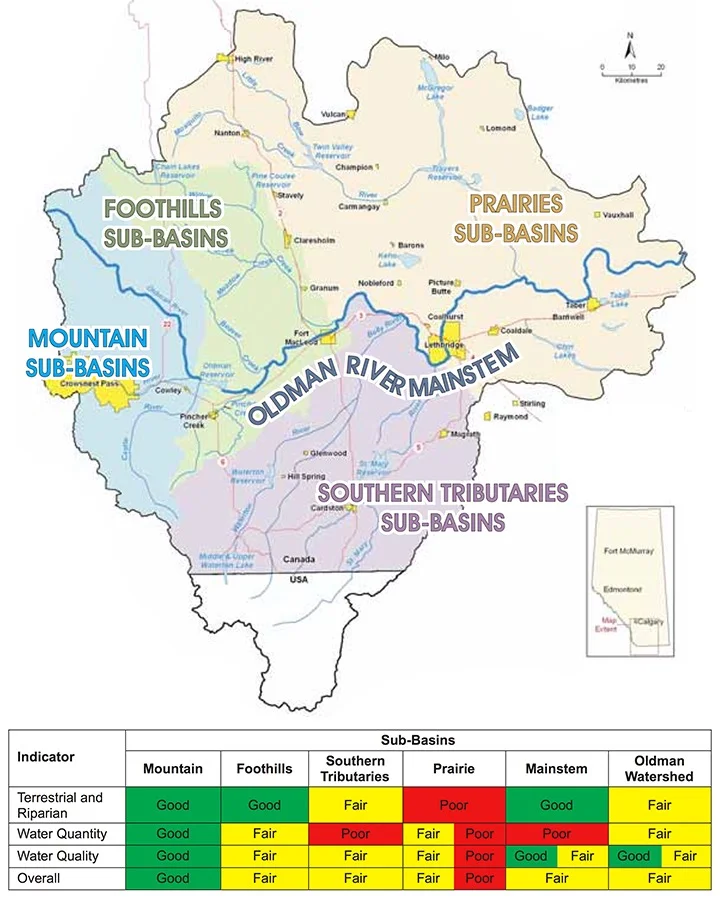
Check out how healthy the land and water are in the sub-basin you live in!
Read a summary of the 2010 State of the Watershed Assessment here or view by chapter:
SUPPORTERS, FUNDERS, & PARTNERS
Thank you to the Government of Alberta for supporting this work and to Andy Hurly, Linda Cerney, and Cheryl Dash for serving on the sub-committee for an updated State of the Watershed assessment.
For their help and expertise during the 2010 State of the Watershed Assessment, thank you to:
Andrew Hurly, University of Lethbridge
Brent Paterson, Alberta Agriculture and Rural Development
Brian Hills, Alberta Environment and Sustainable Resource Development
Doug Kaupp, City of Lethbridge
Farrah McFadden, Alberta Environment and Sustainable Resource Development
Jocelyne Leger, Alberta Environment and Sustainable Resource Development
Kent Bullock, Taber Irrigation District
Shane Petry, Department of Fisheries and Oceans Canada
Wendell Koning, Alberta Environment and Sustainable Resource Development