Banner photo by Kallie Val-Zehan Desruisseaux. Blog by Watershed Stewardship Assistant Chantel Youmans.
The bees are beginning to buzz, leaves are breaking out of their buds, and the warm weather has arrived in full force—it’s finally springtime! As we transition from a tumultuous winter of swinging temperatures and sporadic precipitation, many of us are asking the same question: what kind of water availability and weather can we expect out of the summer?
Drought conditions have increased throughout the province since our fall update, and the minimal precipitation we received, both on the prairies and in the headwaters, means dry conditions are likely to stay the same throughout the summer. Despite not receiving a lot of winter precipitation, reservoir levels throughout the watershed indicate ample water supply for the time being, which has translated to a generous water allocation for irrigators. However, climate forecasts indicate a shift to El Niño conditions that will bring a warm, dry summer to the province.
Current Conditions
Drought
As of mid-April, the Government of Alberta has updated the drought conditions within the Oldman watershed from Stage 1: None to Stage 2: Minor. At this level, variable water supply can have moderate negative impacts on the environment such as reduced wildlife habitat and lowered water quality, but access to water for human needs remains reliable and damage to local water systems is reversible.
While basin conditions are stable, drought analysis conducted by the Canadian Drought Monitor indicates that dry conditions are spreading across the prairie regions of the watershed. The majority of the Oldman watershed ranges from D0 - Abnormally Dry to D2 - Severe Drought.
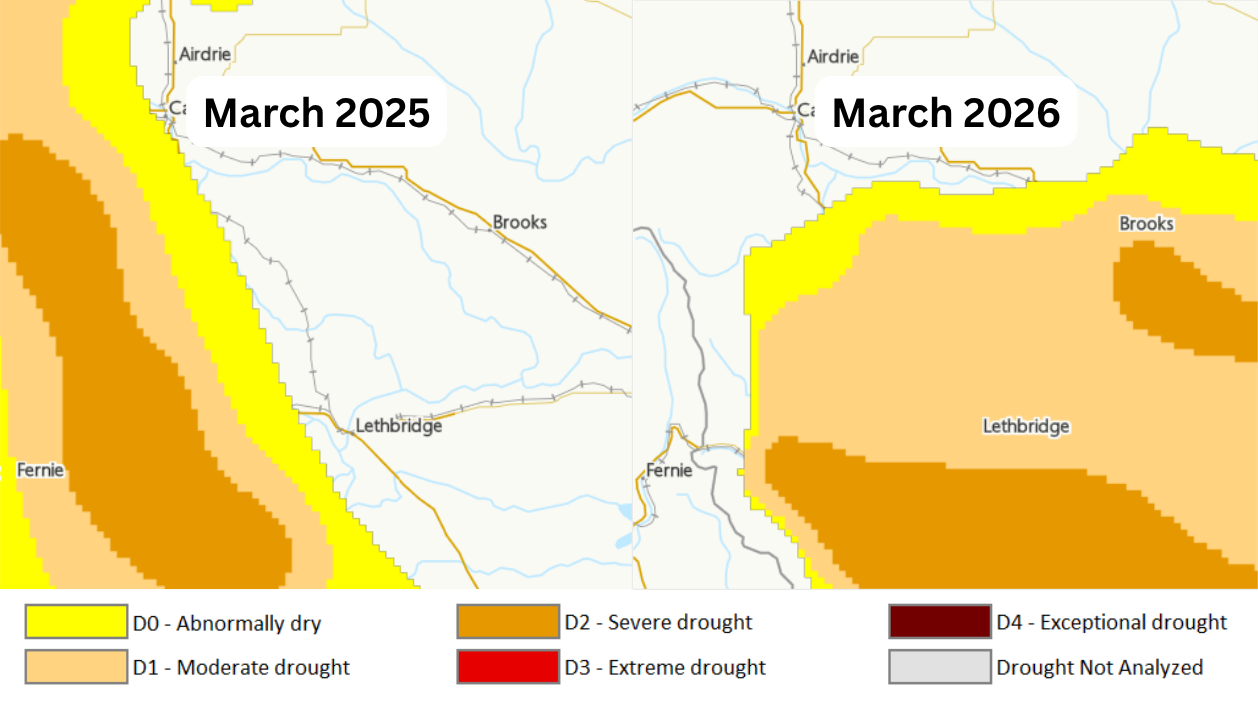
The Canadian Drought Monitor provides real time and historic maps to compare drought intensity across the various regions of Canada. From this graphic, we can see that drought conditions are present in a greater area of the watershed compared to 2025, increasing in severity from the northern to the southern extents. Map adapted from Agriculture and Agri-Food Canada, 2026.
Expanding drought conditions throughout the watershed and province could lead to changes in water management throughout the growing season, including the implementation of water sharing agreements. As of early May, there are no active water sharing agreements or other drought response initiatives in place. The Government of Alberta outlines the many regulatory and non-regulatory measures that may be taken to manage drought conditions in the Alberta Drought Response Plan.
Water Supply
Reservoir levels have rebounded since we last checked in during the fall. The majority of reservoirs within the watershed are within or above their expected water levels, and of our four major reservoirs, three are reporting water levels above the normal range. The St. Mary reservoir alone is sitting at 97% of its maximum capacity, exceeding the normal range by 29%.
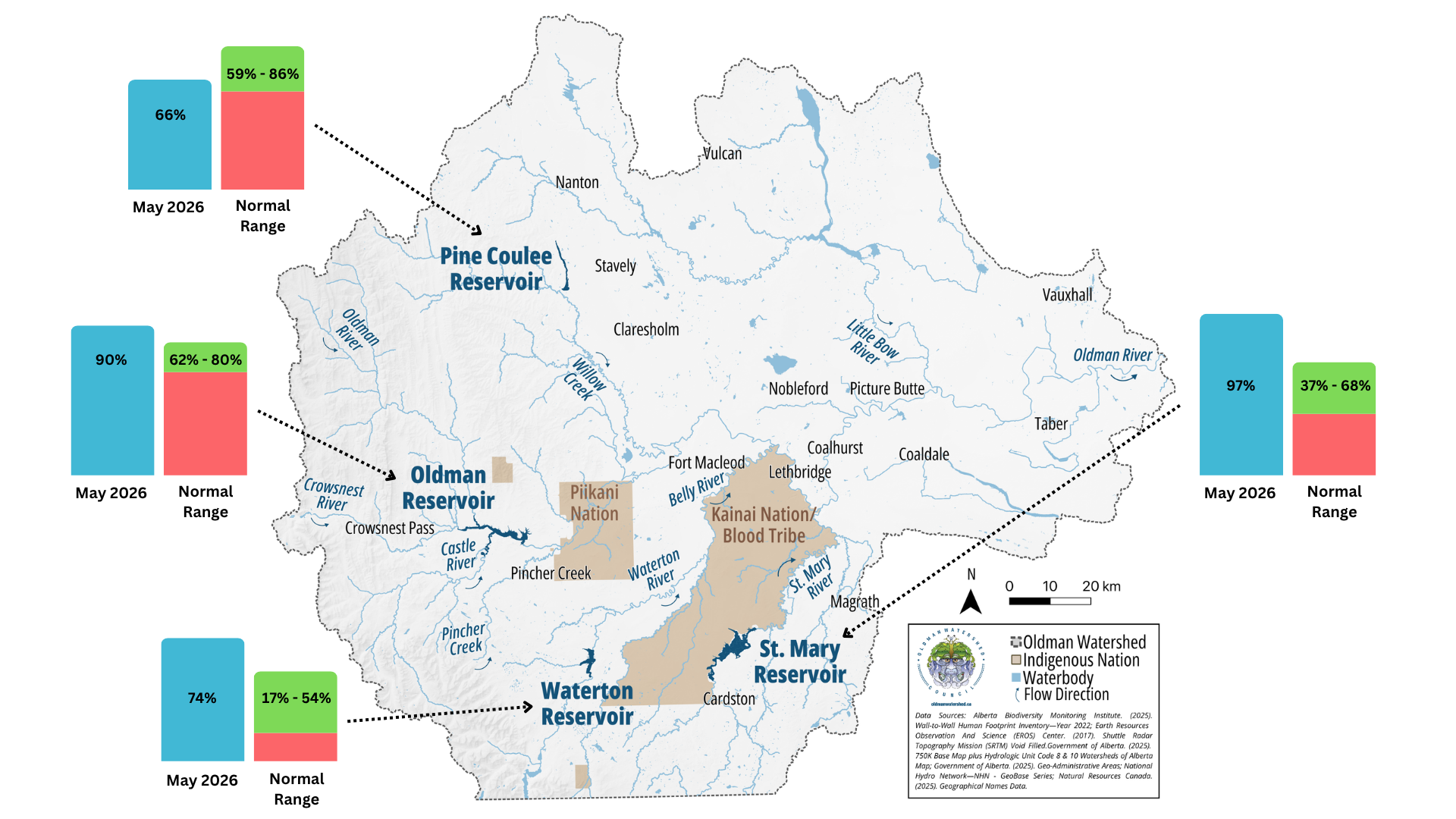
The water levels in the four major storage reservoirs in the Oldman watershed (Oldman, Waterton, St. Mary, and Pine Coulee reservoirs) as of May 2026, compared to the normal ranges for each. Map: Lauren Thompson; data collected from Alberta Rivers.
Increased water availability is providing a measure of confidence for local irrigators, and St. Mary River Irrigation District (SMRID) has set the water allocation for the 2026 season to 14” for irrigators. This is higher than in 2024, when allocation was set to 9”, and 2025, when it was set to 12”. Warm winter weather and investments in off-stream water have contributed to higher reservoir levels than we have seen in recent years, allowing SMRID to increase the water allocation we’ve seen over the past few years.
Water Shortage Advisories
The Oldman watershed currently has four active water shortage advisories, three of which have been in place since August 2025. Advisories that remain in place over the winter are not updated until the ice and frozen conditions of the water body melt enough to allow for accurate data collection, so we may see updates to these in the coming weeks. However, the fourth, and newest, advisory for Willow Creek was created at the end of April 2026, meaning it is reflective of current conditions and not likely to change until water availability improves.
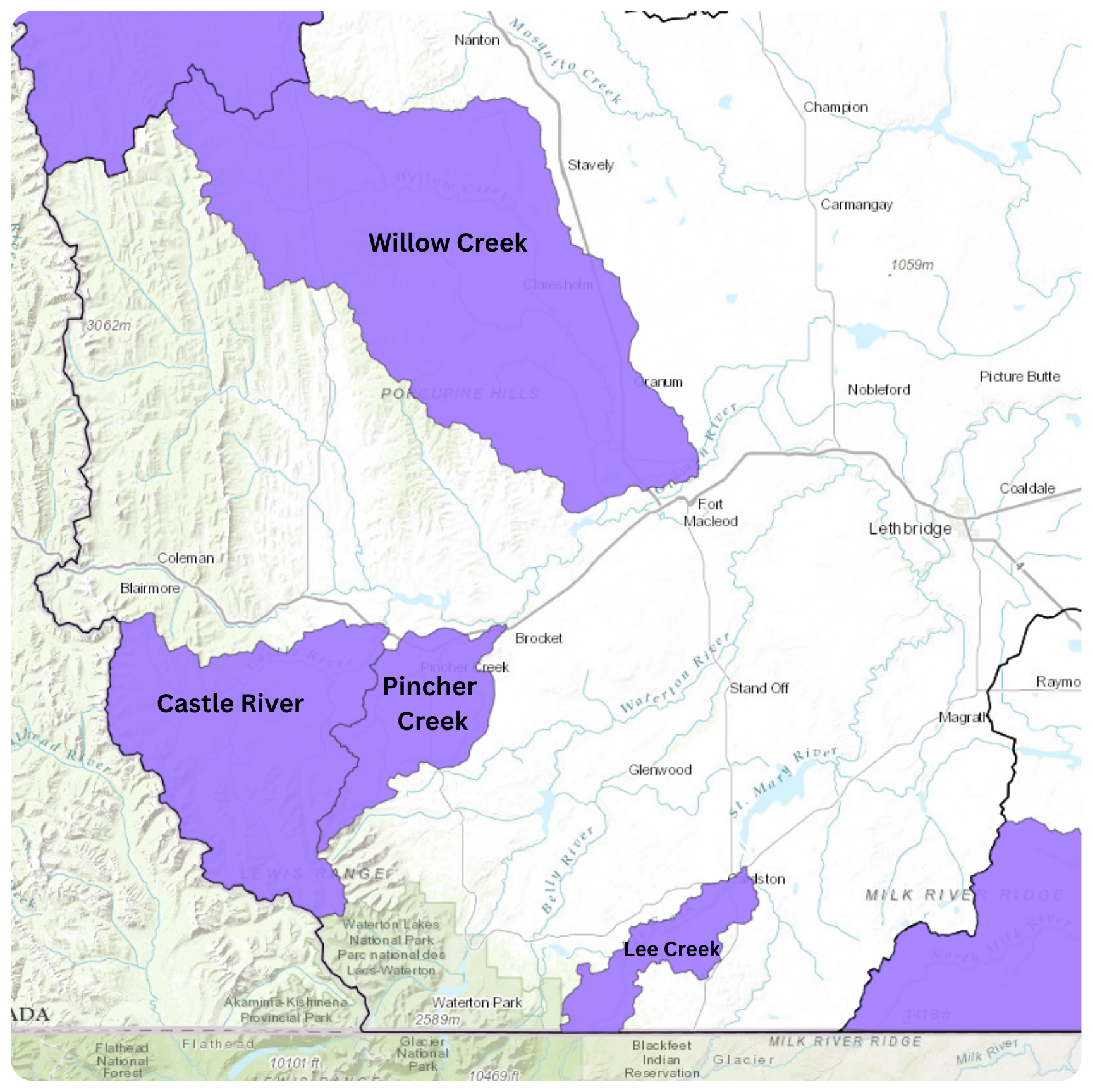
Current water management advisories within the Oldman watershed. During an advisory, the provincial government may pause Temporary Diversion Licenses (TDL) for surface and/or ground level water withdrawals; new TDLs are considered only on a case-by-case basis. Term licensed withdrawals may also be affected, allowing senior water license holders to make priority calls according to Alberta’s ‘First in Time, First in Right’ water policy. Map adapted from Alberta Rivers.
Winter Precipitation
Total accumulated precipitation for the winter season of 2026 was lower than winter 2025, notably in the foothills regions of the watershed. Swaths of the prairie regions in the east and south are slightly drier than last year, but the dry conditions that many have come to expect from the prairie have also spread west to the foothills—regions that typically retain more moisture. In the map below, you can see that in 2025, there was a pocket of moister conditions near Pincher Creek that has since diminished in 2026. Precipitation in the far west edge of the watershed, along the eastern slopes, remains nearly unchanged.
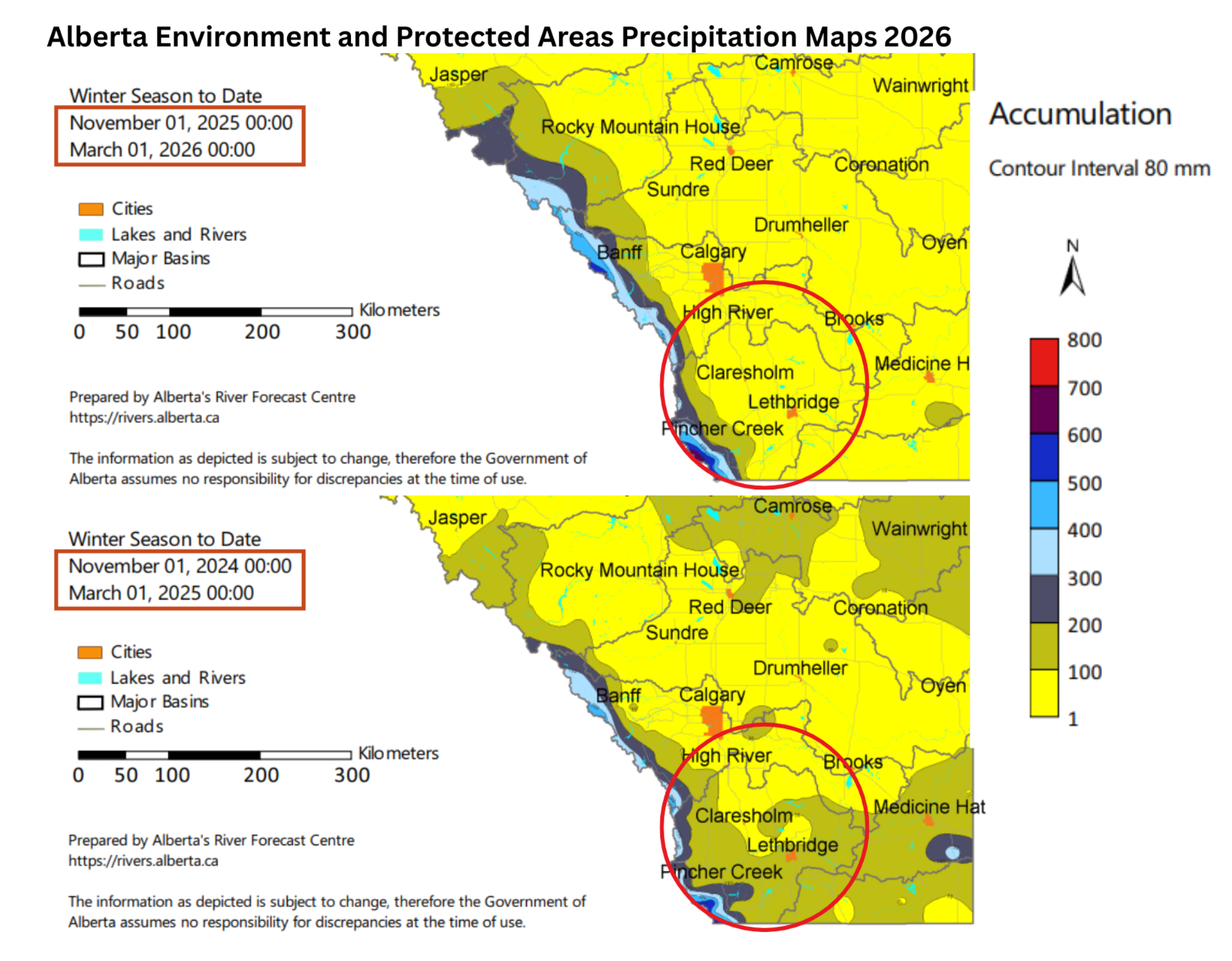
Precipitation maps from the winter season of 2026 (top) and 2025 (bottom). Pincher Creek, in the bottom left of the red circle, shows a notable decrease in precipitation from 2025 to 2026 Maps adapted from Alberta’s River Forecast Centre.
Snowpack
This past winter also brought a highly variable amount of snow to the headwaters of the Oldman watershed. Mountain snow surveys conducted in early April report snowpack in the headwaters ranging from well below normal to normal. Snow survey results from the southern portions of the headwaters report the lowest results, with a station near Lee Creek reporting 29% of the expected snowpack based on historical data. Monitoring stations in the middle of the headwaters show average to just slightly above average accumulation of snow. South Racehorse Creek reported 105% of expected snowpack, and Gardiner Creek is on the upper end of the normal range as well (shown below).
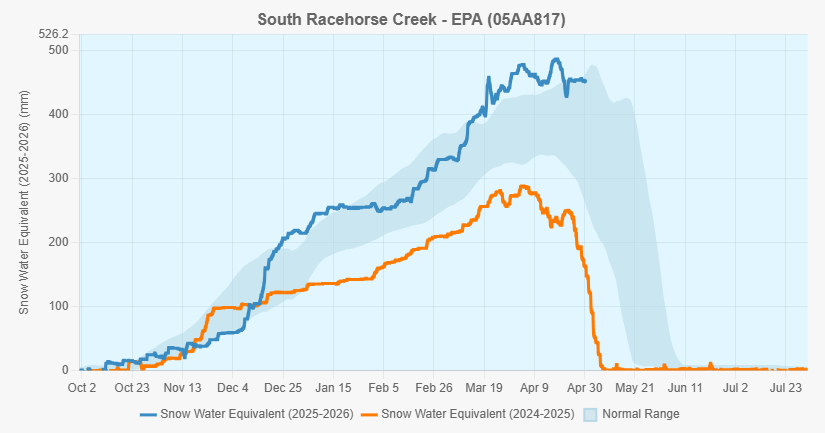
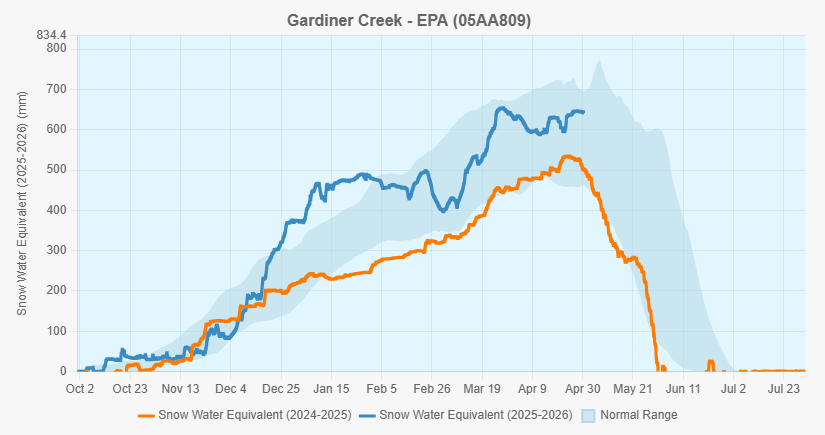
Top image: Snowpack accumulation in South Racehorse Creek for the 2025–2026 season (blue) and 2024–2025 season (orange), as compared to the normal range for the season (blue shaded area). Bottom image: Snowpack accumulation for Gardiner Creek for the 2025–2026 and 2024–2025 seasons. Snow water equivalent (SWE) refers to the amount of liquid water contained within snow in millimeters. Snowpack data is converted to SWE for water management and forecasting. Data from Alberta Rivers.
Stream Flows
As of May 5, stream flow in the Oldman River is around 64.7 m³/s, which is in the upper range of normal flows for this time of the year. Water levels and flow steadily decreased at the end of April before beginning to rise again beginning of May, and will likely remain elevated for some time. The Water Supply Outlook for April shows that snowmelt is already complete for the prairies, but mountain runoff is expected to continue for a few more weeks or even months, further contributing to high flows around this time of year. Stream flow is managed in the Oldman River by the presence of the reservoir upstream and cannot reach historical high levels; if 2026 follows the 2025 trend, the Oldman River may stay high throughout May and June before tapering off in the later summer once mountain runoff is complete.
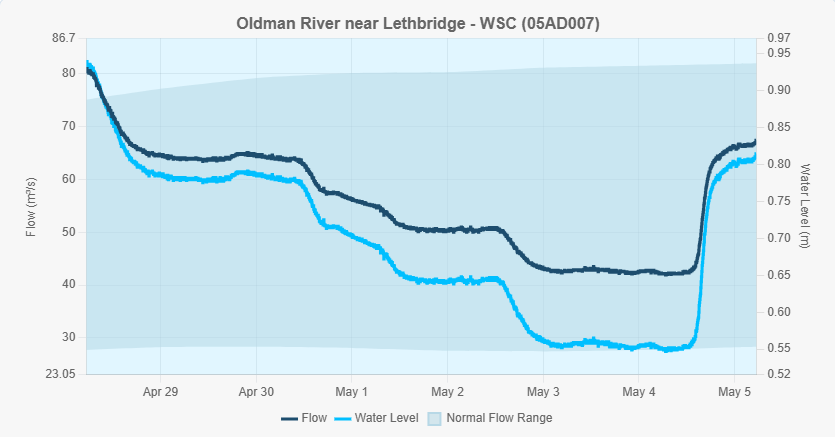
Observed flow (dark blue) and water level (light blue) compared to the normal range (blue shaded area), at a monitoring station near Lethbridge in 2026. Data from Alberta Rivers.
Looking Ahead
Emerging El Niño Conditions
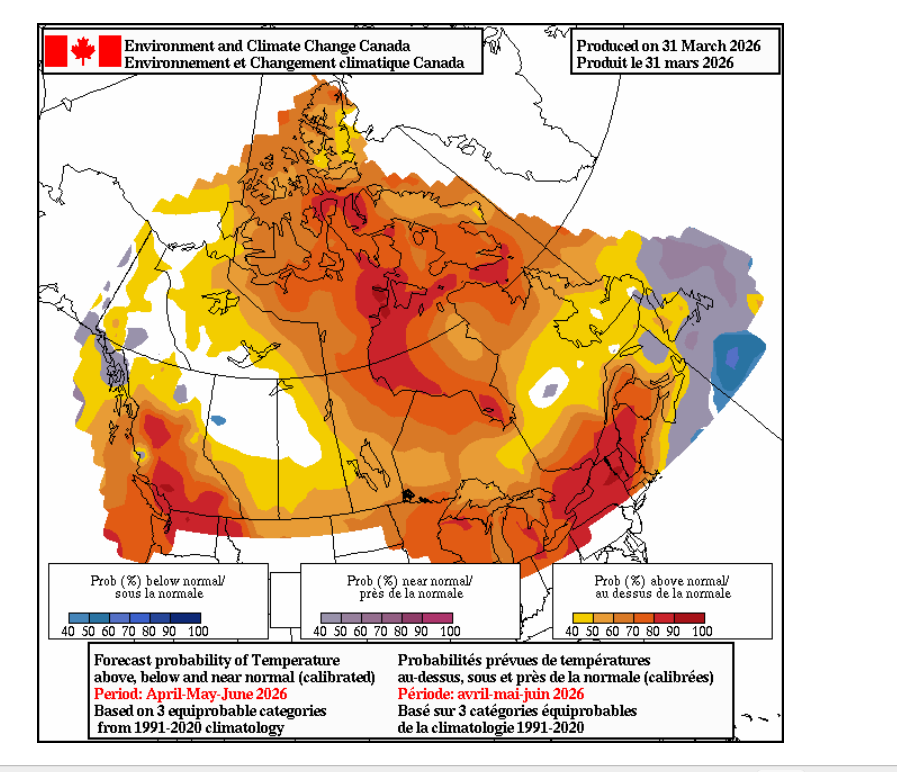
Temperature predictions for Canada, May through July 2026. Forecasting indicates that all of Alberta will experience above average temperatures. Map from Environment and Climate Change Canada, 2026.
Climate predictions from the National Oceanic and Atmospheric Association indicate an 80% chance that our current neutral conditions will persist to the end of May or June before giving way to El Niño conditions that will likely last until the end of 2026. During El Niño conditions, changes to the water temperature of the tropical Pacific Ocean influence temperature and weather systems across the globe. For us here in southern Alberta, that means drier and warmer conditions are more likely, which plays an important role in drought conditions. The May–July temperature forecast from Environment and Climate Change Canada similarly suggests that we will have another hot, dry summer, with a 70% chance of temperatures above the normal range to occur in the watershed. We don't know what precipitation through the summer months will look like in southern Alberta; in the absence of significant summer precipitation, drought conditions are likely to increase.
Conclusion
Conditions are still evolving in the watershed as the seasons change. Snow melt is largely complete in the prairies, but runoff from the melting snowpack in the headwaters will continue to recharge local waterbodies for some time. Water shortage and low flow advisories will also continue to be updated as more monitoring data becomes available, providing guidance for water management throughout the season. Stay up to date with current basin conditions using Alberta Rivers, and keep an eye out for water related news at ABwater.ca.
As we approach another warm and dry season, being water conscious is as important as ever. Although reservoir levels are promisingly high, and there is adequate water supply for our needs, drought conditions are more than likely to persist into the fall. Outdoor water use increases dramatically in the warmer months, but there are many simple ways we can all contribute to water security. We all have a part to play in caring for this beautiful watershed we call home!
Like all OWC’s blogs, this post was written by a real live human, without the use of generative AI.